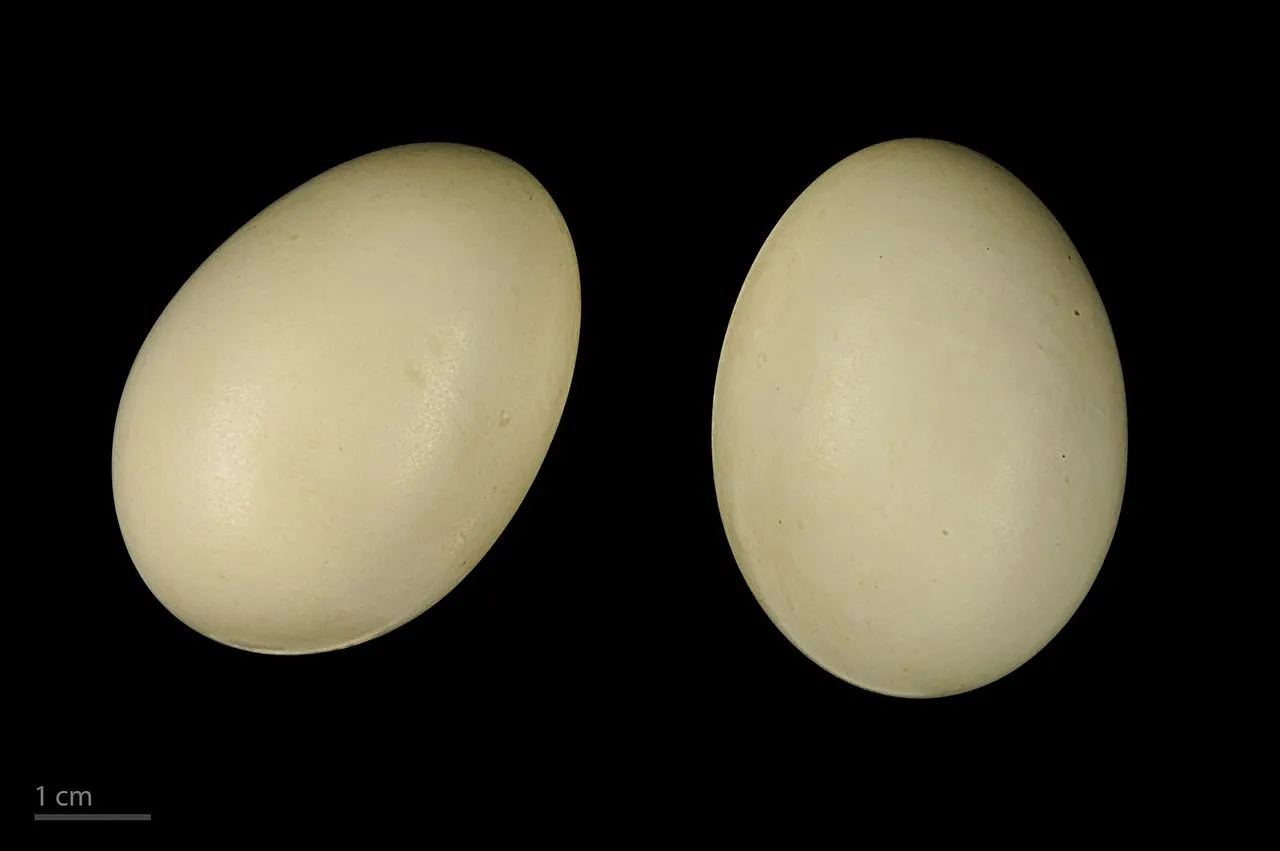
Anas crecca (Linnaeus, 1758), the Green-winged Teal, is the smallest regularly occurring dabbling duck in North America, often only 31-39 cm long and roughly 140-500 g. Its scale is the first identification character: beside Mallard it looks not merely smaller but almost compressed, with a short neck, compact body, and fast, twisting flight.
Part of the Complete Waterfowl Guide.
Identification at a glance
| Character | Green-winged Teal | Blue-winged Teal |
|---|---|---|
| Length | 31–39 cm (12–15 in) | 37–41 cm (15–16 in) |
| Female structure | Compact, short-billed, cold brown | Larger, longer-billed, warmer brown |
| Wing | Green speculum; no blue forewing | Powder-blue forewing; green speculum |
| Migration | Remains farther north later | Leaves northern marshes early |
| Male mark | Chestnut head with green eye patch | Slate head with white facial crescent |
Identification
Visual
The North American breeding male has a chestnut head with a broad iridescent green patch through and behind the eye, bordered narrowly in buff. The body is finely grey, with a vertical white bar at the side of the breast. The undertail is black bordered by cream. The bill is dark and small. The green speculum is bright in flight and bordered by buff or white lines.
Females are small, brown, and finely mottled, with a dark bill and a proportionally neat head. The green speculum is the main plumage mark when visible. Compared with Blue-winged Teal, female Green-winged is smaller, shorter-billed, colder brown, and lacks the obvious pale spot at the bill base often shown by female Blue-winged. The wingbeat is very rapid.
Eclipse males resemble females but retain a darker, warmer head and traces of the side bar. In autumn the facial green returns progressively.
Taxonomy is unsettled in field usage. Eurasian Teal is often treated as Anas crecca crecca and American Green-winged Teal as A. c. carolinensis; some authorities split them. Male Eurasian Teal lacks the vertical white breast-side bar and instead shows a horizontal white scapular stripe.
Audio
The male gives a high, clear whistle, often transcribed as krik or preep. Flocks in winter produce thin conversational whistles. Females give small, high quacks, much weaker than Mallard.
Distribution
Green-winged Teal breeds across Alaska, Canada, the northern United States, and across northern Eurasia where Eurasian Teal occurs. North American birds winter through the United States, Mexico, the Caribbean, and Central America, using all four major flyways. In Britain and Ireland, Eurasian Teal is a common wintering duck on estuaries and inland marshes; American Green-winged Teal is a scarce vagrant usually detected by the vertical white side bar on males.
Habitat
The species uses small, shallow wetlands with muddy edges: sedge marshes, beaver ponds, bog pools, flooded fields, tidal creeks, saltmarsh pans, and sewage lagoons. It is less dependent on large open water than many dabblers. In winter it often feeds on exposed mud at the edge of falling water, where larger ducks cannot work as efficiently.
On estuaries, Green-winged or Eurasian Teal often packs into narrow creeks on a falling tide, then spreads across newly exposed mud. Inland, the same pattern appears on managed scrapes and drawdown pools. Birds may be absent from deep water only metres away from excellent feeding habitat. For surveys, scanning only the centre of a pond undercounts teal; the shaded, muddy, vegetated edge is often where the birds are actually feeding.
Diet and Foraging
Green-winged Teal is a surface-sieving dabbler. The small bill and fine lamellae handle tiny seeds, midge larvae, small molluscs, crustaceans, and plant fragments. It feeds by swimming with the bill partly submerged, dabbling in film water, and picking from wet mud. Upending occurs but is less central than in Mallard or Pintail.
Because of its size, it can exploit very shallow water only a few centimetres deep. Drawn-down impoundments and tidal margins can hold dense flocks, each bird moving rapidly and feeding almost continuously. Animal food increases before and during breeding, especially for females forming eggs.
Breeding Biology
Pairs form in winter and early spring. Nests are on the ground in dense grass, sedge, heather, or low shrub cover, usually near water but often hidden well back from the edge. Clutches commonly contain 6-9 eggs. Incubation lasts about 21-23 days and is performed by the female alone.
The male departs during incubation and moults elsewhere. Ducklings are highly mobile and feed themselves immediately in shallow, invertebrate-rich water. Fledging occurs at roughly 5-6 weeks, faster than in larger dabblers. The small body size reduces absolute food demand but increases vulnerability to chilling, so broods need sheltered, productive margins.
Notes
The main identification problem is not the breeding male but the female and eclipse male among other small dabblers. Size should be judged against nearby birds, not memory. A lone teal on open water can look larger than it is. The combination of small dark bill, compact body, green speculum, and explosive flock flight is more reliable than brown plumage tone.
Flock behaviour is also useful. Teal spring from cover abruptly, often as a tight group, and twist low before gaining height. Mallards lumber upward; shovelers show broad pale forewings; wigeon whistle and often lift from open edges. A flushed teal flock can be identified in two seconds by scale, speed, and cohesion even when individual plumage marks are not visible.
Hybrid and intergrade questions arise where American and Eurasian forms meet or where vagrants occur. A single vertical or horizontal white line should be checked for symmetry, moult state, and feather wear. Mud, displaced flank feathers, or partial moult can imitate a structural mark. Good documentation includes both sides of the bird and, ideally, an open-wing view showing the speculum pattern.
See Also
- Blue-winged Teal: related teal with earlier migration schedule and blue forewing; compare female identification and habitat tolerance
- Mallard: much larger dabbler often sharing the same wetlands; useful size reference in mixed flocks
- Northern Shoveler: shallow-water filter-feeder that often uses the same productive marshes
- Great Blue Heron: familiar marsh wader sharing the same edge habitat and shallow feeding zones
- The Complete Waterfowl Guide: full family overview including dabbler foraging, eclipse plumage, and flock identification
How to identify a Green-winged Teal in mixed duck flocks
Size is the first clue. Green-winged Teal look compact beside Mallards, Gadwall, and shovelers, and flocks often lift in tight, quick bursts. For field checks where teal, wigeon, and shovelers overlap, North American Ducks, Geese and Swans: Identification Guide is useful because it compares similar ducks across plumages. As an Amazon Associate, we earn from qualifying purchases, at no extra cost to you.
- Male: chestnut head, green face patch, gray body, and a vertical white bar near the shoulder.
- Female: small warm-brown dabbler with a dark bill and a green speculum that may only show when she preens or flies.
- Behavior: feeds in shallow water and mud edges, often in tight groups that flush quickly.
FAQ: Green-winged Teal female ID
How do you tell a female Green-winged Teal from other small brown ducks? Look for the tiny size, compact shape, dark bill, and green speculum. If the bird is feeding beside larger dabblers, the size difference is usually easier to see than the markings.
Female Green-winged Teal ID in poor light
Female teal are easy to overthink. Start with scale. If the duck looks much smaller than nearby Mallards, Gadwall, or shovelers, Green-winged Teal should be on the list. Then check the dark bill, compact body, and quick, twisting flush. The green wing patch is helpful, but it is not always visible on a resting bird.
- Best clue: tiny size beside other dabbling ducks.
- Useful field mark: green speculum when the wing opens.
- Behavior clue: tight flocks that lift fast from shallow water or mud edges.
As an Amazon Associate, we earn from qualifying purchases, at no extra cost to you. For distant marsh ducks, compare waterproof 8x42 birding binoculars here: helpful product options on Amazon
Sources & References
- Ehrlich, P.R., Dobkin, D.S. & Wheye, D. (1988). The Birders Handbook. Simon & Schuster.
- Cornell Lab of Ornithology. (2024). All About Birds: Green-winged Teal. birds.cornell.edu
- Sibley, D.A. (2014). The Sibley Guide to Birds (2nd ed.). Knopf.
- Carboneras, C. & Kirwan, G.M. (2024). Green-winged Teal (Anas crecca). Birds of the World.