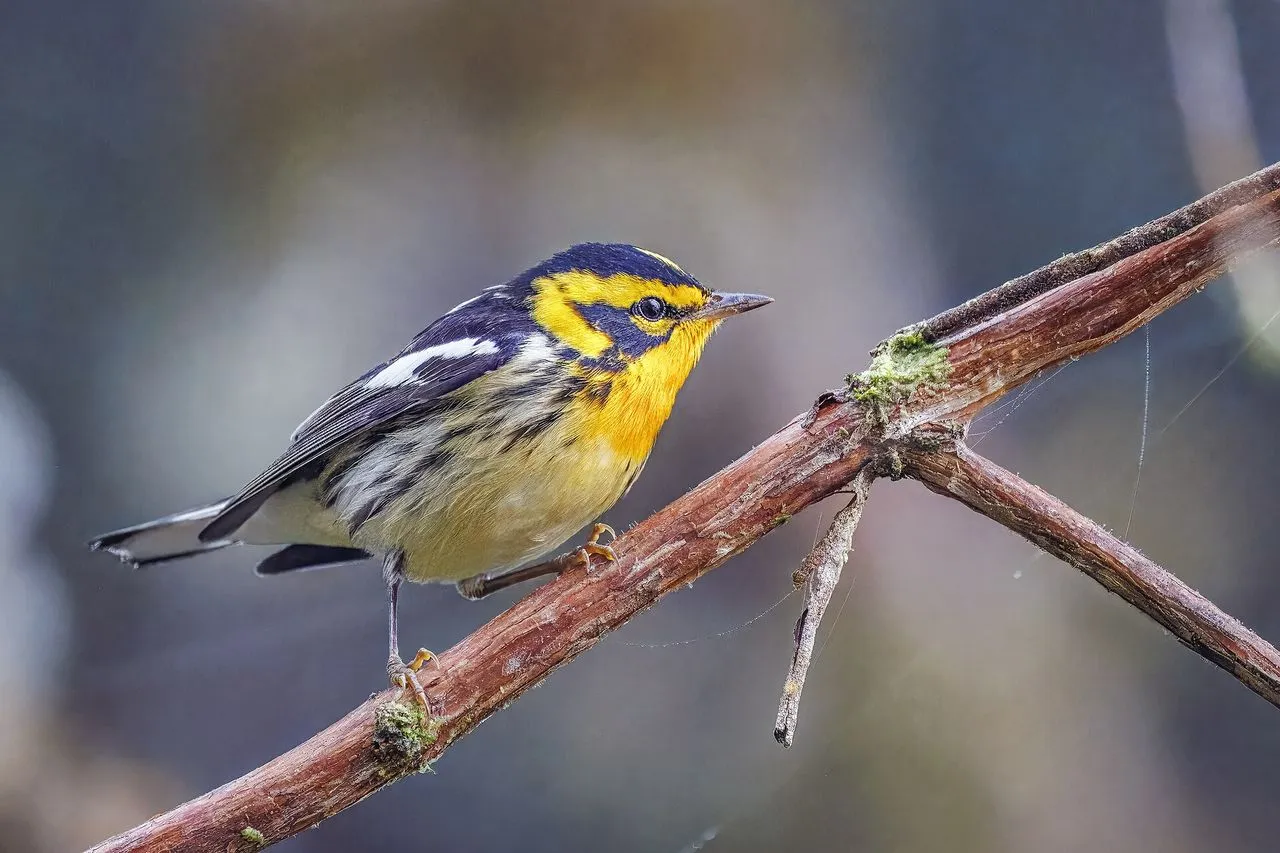
Blackburnian Warbler (Setophaga fusca) has the most intense orange throat of any North American warbler (11–13cm, 8–13g). Males are flame-orange with black face. Forages in treetops. Breeds in coniferous forests.
Setophaga fusca Muller, 1776, the Blackburnian Warbler, is an 11 to 13 cm canopy warbler of about 8 to 13 g whose breeding male carries the most intense orange throat of any North American parulid.
Part of the Complete Warblers Guide.
Identification at a glance
| Feature | Blackburnian Warbler (Setophaga fusca) | Key separator |
|---|---|---|
| Breeding male | Fire-orange throat and face with black cheek patch | Orange is centred on the throat, not just the face |
| Female or autumn | Yellow to pale orange throat, pale supercilium, wing bars | Retains streaked back and dark cheek area |
| Song | Rising zip-zip-zip-zip-tseeeee with very high finish | Terminal note may be above some hearing ranges |
| Size | 11 to 13 cm (4.3 to 5.1 in), 8 to 13 g (0.3 to 0.5 oz) | Small canopy warbler, usually high overhead |
| Primary habitat | Mature spruce, fir, hemlock, and mixed canopy | More conifer-linked than Cerulean Warbler |
Identification
Visual
Breeding males show a fire-orange throat and face, black triangular cheek patch, black crown and back with white streaks, white wing patch, and yellow-orange breast shading to white below. Females and autumn birds are duller, with yellow to pale orange throat, grey-green upperparts, and weaker facial contrast, but they retain a pale supercilium, dark cheek area, wing bars, and streaked back.
The bird is usually high. Neck angle is part of the identification experience: Blackburnian Warblers forage near the outer canopy of hemlock, spruce, fir, and mature deciduous trees. In spring migration males may descend to eye level after cold fronts, but on breeding territories they often remain 15 to 30 m above ground. Cape May Warbler (Setophaga tigrina) can show orange in the face, but has a different cheek pattern, finer bill, and stronger association with spruce budworm outbreaks; Blackburnian's glowing throat is centred and clean. For comparison, the Magnolia Warbler shares the boreal canopy zone and similar tail pattern, while the Cerulean Warbler occupies a different niche in mature deciduous canopy to the south.
Audio
The song is a thin, rising series that often accelerates into an extremely high terminal note: zip-zip-zip-zip-tseeeee. The final note may vanish above the hearing of some observers. Males sing from high canopy perches, and the song's direction can be hard to locate because the high frequencies reflect and attenuate through foliage.
Calls are sharp chips typical of migrant warblers. During migration, visual pattern is usually more useful than call. On breeding grounds, the high rising song from mature conifer or mixed canopy is the best way to locate territories.
Distribution
Breeding range extends from the southern boreal forest of Canada through the Great Lakes, New England, Adirondacks, and Appalachian Mountains, with local populations in suitable mature conifer or mixed forest. It is most numerous in regions with hemlock, spruce, fir, and mature mixed woodland.
Spring migration occurs mainly from April through May across eastern North America. Autumn migration begins in August, peaks in September, and continues into early October. Winter range lies primarily in the Andes and adjacent montane forests from Colombia and Venezuela south through Ecuador, Peru, and Bolivia, where birds often occupy cloud forest and shade-grown agricultural mosaics.
Habitat
Breeding habitat is mature coniferous and mixed forest. In the north it uses spruce-fir, hemlock, and mixed boreal stands; in the Appalachians it is strongly associated with mature hemlock and high-elevation conifer-hardwood forest. Tall trees, complex canopy structure, and abundant outer foliage are more important than dense understory.
During migration the species appears in deciduous parks, oaks, maples, coastal woodlots, and garden trees, but it still tends to work high unless weather forces birds lower. On wintering grounds it uses montane forest, forest edge, and shade coffee at middle elevations, often joining mixed-species flocks.
Diet and Foraging
Blackburnian Warblers feed on caterpillars, beetles, flies, aphids, scale insects, spiders, and other small arthropods. They glean from needle clusters, leaf undersides, and twig tips, frequently hovering at the ends of branches. The long axis of their foraging world is horizontal outer canopy, where prey density can be high and competition is divided among several canopy specialists.
Spruce budworm and other defoliating caterpillars can provide abundant prey in outbreak years, and local densities may rise where larvae are plentiful. During migration, birds also take small berries occasionally, but insects remain the primary food.
Breeding Biology
Nests are difficult to observe because they are placed high, usually 5 to 25 m above ground and sometimes higher, on horizontal conifer limbs. Females build a cup of twigs, bark, rootlets, lichens, and plant down, often saddled on a branch and concealed by needles.
Clutch size is generally 4 or 5 eggs. Incubation lasts about 12 days, mainly by the female. Both parents feed the young, which fledge after roughly 10 to 12 days. The height of the nest reduces some ground-predator risks but exposes nests to canopy predators and severe weather. One brood is typical in the northern range.
Notes
Hemlock decline from woolly adelgid infestation threatens breeding habitat in parts of the Appalachians and north-eastern United States. The species is not dependent on hemlock everywhere, but the loss of mature hemlock removes a cool, humid canopy structure used by Blackburnian Warblers and several other forest birds. Watching this warbler well often requires waiting beneath the tree rather than chasing movement; the bird may complete a circuit and return to the same outer branches.
See Also
- American Redstart: another active canopy forager with bold tail displays and overlapping boreal range.
- Magnolia Warbler: boreal breeding neighbour with a distinctive white tail pattern.
- Cerulean Warbler: the threatened canopy warbler of mature eastern hardwoods, a species facing similar habitat pressures.
- Pine Warbler: the parulid that also uses pine and conifer canopy and ventures to feeders.
- The Complete Warblers Guide: full family reference: taxonomy, migration, and identification structure.
Frequently Asked Questions
How do I identify Blackburnian Warbler?
Male: flame-orange throat and face, black head, white wing patch. Female: yellow-orange throat, grey head. The intensity of orange is unique among warblers. In fall, both sexes show yellow instead of orange.
Where does Blackburnian Warbler breed?
Coniferous and mixed forests across Canada and the northeastern US. Found in spruce, fir, and hemlock at higher elevations. Forages high in the canopy, often heard before seen.
What does Blackburnian Warbler eat?
Insects and spiders, gleans from foliage in the canopy. Will occasionally take berries. One of the most canopy-specialized warblers.
Does Blackburnian Warbler use feeders?
Rarely, they are exclusively canopy foragers. Best found by learning their high-pitched song in mature coniferous forest.