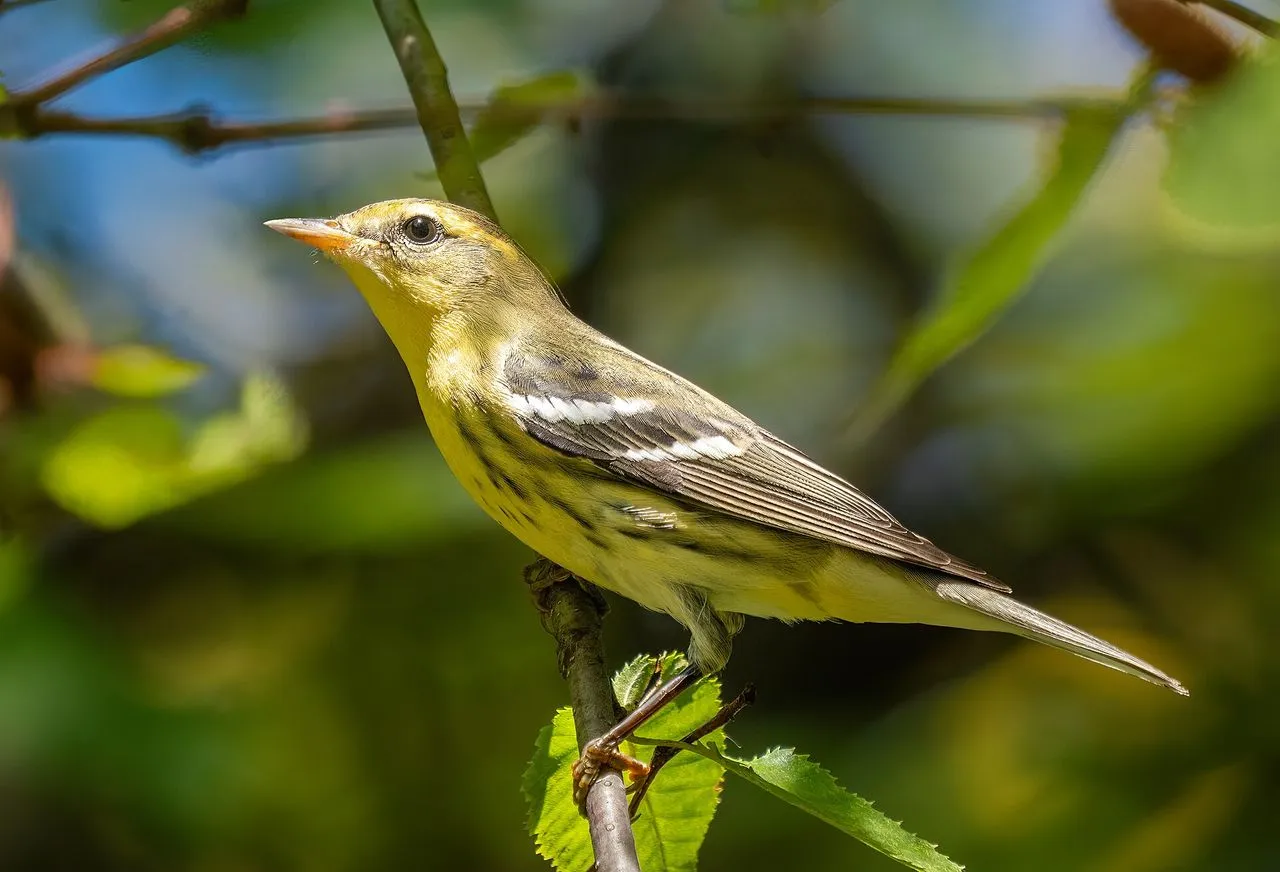
'Warbler' covers two unrelated lineages: New World Parulidae (American Yellow-rumped, Blackpoll, etc.) and Old World Sylviidae (now split into Phylloscopidae, Acrocephalidae, Locustellidae). They are convergent, similar ecology drove similar body plans. Parulidae warblers are small, often brightly coloured, insectivorous, and migrate at night. Most do not visit feeders but can be attracted with water and native plantings that host insects.
The word "warbler" covers two only-distantly-related lineages that arrived at similar ecological niches by convergent evolution: Parulidae, the New World warblers of the Americas, and a cluster of Old World families historically lumped as "Sylviidae" that molecular systematics has since divided into several distinct lineages with no close relationship to the American group.
I'm Dr. James Whitfield, Oxford-trained ornithologist with more than 12,000 documented hours of field and garden observation, and a former research associate with the British Trust for Ornithology. This guide is a field reference for the backyard birder: how to distinguish the families, locate them in the field, interpret their songs, and understand their seasonal movements.
Taxonomy: Convergent Names, Divergent Origins
The "Old World warbler" problem preoccupied systematists for most of the 20th century. Sylviidae as traditionally constituted was an enormous, morphologically untidy family built around a shared body plan: small, insectivorous, largely brown or olive, inclined to stay hidden in vegetation. Molecular phylogenetic analyses published through the 1990s and 2000s confirmed what morphological work had long suspected. The old Sylviidae was polyphyletic, a collection of lineages grouped by ecological similarity rather than common ancestry.
What was once a single family is now distributed across at least six. Sylviidae sensu stricto retains the typical warblers: the blackcap (Sylvia atricapilla), the whitethroats (Curruca communis, Curruca curruca), and the garden warbler (Sylvia borin). Phylloscopidae holds the leaf warblers: willow warbler (Phylloscopus trochilus), chiffchaff (Phylloscopus collybita), and wood warbler (Phylloscopus sibilatrix). Acrocephalidae contains the reed and marsh warblers (Acrocephalus species). Locustellidae takes the grasshopper and river warblers. Cettiidae covers the bush warblers and allies. A birder identifying a chiffchaff in a British hedgerow and a sedge warbler in a Norfolk reedbed is, technically, crossing a family boundary.
Parulidae has a considerably cleaner taxonomy. The family has long been recognised as a coherent New World lineage, though its position within the broader passerine tree was debated. Current molecular work places Parulidae within the nine-primaried oscine clade alongside Cardinalidae (cardinals and grosbeaks), Icteridae (blackbirds and orioles), and Thraupidae (tanagers). The family contains approximately 110 species in 18 genera, with its centre of diversity in Mexico and Central America.
The practical consequence for the observer: these two groups share a foraging niche, a general body shape, and a name. They share little else that is useful for identification or for predicting behaviour.
Identification Structure
Knowing which characters to assess first saves time, particularly in the brief intervals warblers allow. The working hierarchy: overall size and shape, bill form, feeding height and behaviour, tail action, then plumage.
Size and Shape
Most Parulidae fall in a narrow size range, roughly 10 to 15 cm body length, with a compact round head, short neck, and body mass of 5 to 10 g. Old World sylviid-group warblers span a slightly wider range, from 9 cm in some Phylloscopus to 18 cm in large Acrocephalus reed warblers, but most garden-context species fall in the same 11 to 14 cm bracket.
Primary projection, the distance the folded primary feathers extend past the tertials, is more useful in field identification than most observers apply it. Long-distance migrants carry proportionally longer, more pointed wings, producing a noticeably longer primary projection than sedentary or short-distance species. A willow warbler (Phylloscopus trochilus), which crosses the Sahara twice a year, has significantly longer primary projection than a Cetti's warbler (Cettia cetti), which rarely moves more than a kilometre from its breeding site.
Bill Form
Bill shape sorts warblers by ecology reliably. Most parulids carry a fine, slightly decurved bill suited to gleaning arthropods from leaf surfaces. The yellowthroats (Geothlypis) carry a slightly heavier bill adapted to probing dense stems. In the Old World, Phylloscopus bills are very fine and pointed; Sylvia bills are slightly heavier with a small hook at the tip, consistent with a diet that includes berries in autumn; Acrocephalus bills are laterally compressed and sharp-pointed for probing between reed stems.
Tail Action and Posture
Phylloscopus leaf warblers quiver or flick the wings and tail repeatedly whilst perched, a behaviour so consistent it identifies the genus at distance before plumage can be resolved. Sylvia warblers cock and fan the tail, often raising it above horizontal. Among parulids, the American redstart (Setophaga ruticilla) droops and fans its tail as an active foraging display designed to flush insects from foliage; most other parulids pump or flick the tail moderately. Reed warblers (Acrocephalus) adopt a horizontal, stretched posture as they climb vertically through reed stems, unlike any other warbler group.
Feeding Height
Parulids partition foraging height measurably in woodland. The black-throated green warbler (Setophaga virens) works the upper spruce canopy; the ovenbird (Seiurus aurocapilla) walks the forest floor; the black-and-white warbler (Mniotilta varia) spirals along bark in nuthatch fashion. The Yellow Warbler forages low in willows and shrubby wetland margins; the Common Yellowthroat rarely rises above the lowest metre of dense cattail and sedge. Identifying the foraging zone narrows the search before the bird has shown itself.
Song
Song is the primary field character for most warblers and the one that rewards early investment. In the breeding season, many species are more reliably identified by ear than by plumage, particularly in dense vegetation where a clear view is rare.
Phylloscopus songs are clean, descending or ascending note sequences with a characteristic terminal figure: the willow warbler's liquid cascade, the wood warbler's spinning-coin trill. Sylvia songs are rich and varied, often incorporating mimicry; the garden warbler is one of the more accomplished avian mimics in the European avifauna. Acrocephalus species repeat motifs in a churring, repetitive sequence with little melodic development, making them recognisable as a group before the species is resolved.
Among Parulidae, a broad acoustic division exists between species with high-frequency "zee"-type songs, often above 8 kHz (Cape May, blackpoll, bay-breasted warblers), and species with lower, carrying songs that work across open habitat (yellow warbler, common yellowthroat). The first group presents consistently to observers past 50, whose upper-frequency hearing has typically contracted. If certain warblers that companions detect easily remain inaudible to you, frequency range is the more likely explanation than volume.
Songs change significantly through the season. The primary advertising song of May is replaced by a quieter secondary song by July; by August, most temperate-zone warblers are effectively silent. Autumn migration is conducted without song. Contact calls become the main acoustic tool from September onwards: most parulids give a short dry "chip" call, varying in quality between species. The calls are sharper and more metallic in Dendroica-complex species, softer and duller in Geothlypis yellowthroats.
Migration Timing and Fallout Conditions
Parulidae breeding in North America concentrate spring movement northwards between late April and late May across the eastern flyway, with early species reaching the Gulf States from late March. Autumn movement is more extended: adults leave breeding territories from late July, with the bulk of juveniles moving through September into October.
Fallout events occur when a cold front drives south across the migration corridor during peak movement. Birds flying northward at altitude encounter headwinds and grounding conditions and come down into whatever habitat lies beneath them. A northward-moving cold front in the first two weeks of May, particularly following overnight rain, produces the highest warbler densities of the year at sites like Magee Marsh in Ohio and High Island on the Texas coast. The mechanism is straightforward: birds that have flown several hundred kilometres overnight reach a weather barrier and must feed immediately. Work low scrub, willow edges, and any fresh water drip in the 48 hours following such a front.
In the Old World, the same system operates along the Atlantic and Mediterranean flyways. Vagrant Phylloscopus warblers from Siberia drift west on autumn anticyclones and appear on British and Irish headlands with useful regularity from late September to early November.
How to Find Them
The two-hour window after dawn in the breeding season is the most productive period for warblers, consistently and by a wide margin. Males sing heavily from first light until around 09:00, then activity drops. A second, shorter peak occurs in late afternoon. Outside these windows, tracking warblers through the middle of the day means working habitat edges, following chip calls, and waiting at the margins of whatever mixed-flock activity is present.
In autumn, mixed flocks are the structure to exploit. Migrating warblers attach to tit or chickadee flocks, using the flock's collective vigilance to maintain anti-predator cover whilst feeding. A single active tit flock in October woodland in eastern North America regularly carries six to eight warbler species. In Britain and western Europe, long-tailed tit flocks in October serve the same function, often accumulating chiffchaffs and the occasional rarer Phylloscopus.
Habitat selection is consistent enough to be predictive. Wet scrub edges and willow margins hold yellow warblers and yellowthroats in the breeding season; dry woodland edge and brushy second-growth are where redstarts and worm-eating warblers concentrate; mature forest interior is the domain of the ovenbird and the black-and-white warbler. In winter, neotropical migrants integrate into mixed-species flocks in secondary growth and forest edge across Central America.
Common Confusions
| Confusion pair | Key separator |
|---|---|
| Yellow Warbler vs. Wilson's Warbler | Wilson's has a solid black cap; Yellow Warbler male has reddish breast streaks, no cap |
| Common Yellowthroat vs. MacGillivray's Warbler | MacGillivray's grey hood extends to the upper breast; Yellowthroat has a clean white-bordered black mask |
| Willow Warbler vs. Chiffchaff | Willow Warbler has pale flesh-pink legs and a longer, cleaner supercilium; Chiffchaff has dark legs and a buffish face |
| Garden Warbler vs. Barred Warbler | Barred Warbler is noticeably larger with a pale eye and fine barring on the underparts |
| Nashville Warbler vs. Connecticut Warbler | Connecticut is substantially larger with a complete bold eye ring; Nashville has a broken eye ring |
Notable Species
The following are the warbler species most likely in suburban and backyard settings across North America. For British and western European observers, the Sylvia warblers, particularly the blackcap and the common whitethroat, are the most likely garden visitors.
- Yellow Warbler: the most geographically widespread breeding parulid; present across virtually all of North America in suitable shrubby wetland habitat from late April to August.
- Common Yellowthroat: abundant, masked, and thoroughly hidden in cattail and low marsh vegetation across the continent.
- Setophaga coronata (Yellow-rumped Warbler), the only parulid that regularly overwinters in temperate North America, shifting to berries when insects fail.
- Setophaga ruticilla (American Redstart), bold black and orange plumage in the male; common in second-growth deciduous woodland.
- Mniotilta varia (Black-and-white Warbler), creeps along bark in nuthatch fashion; produces a high, repetitive squeaky-wheel song that carries well.
- Seiurus aurocapilla (Ovenbird), terrestrial, walking the forest floor; the domed nest gives the species its name.
- Setophaga pinus (Pine Warbler), one of the few parulids that regularly visits suet and millet feeders, mainly in the south-eastern United States.
For related families, see the complete finches guide and the complete thrushes guide. For setting up habitat to attract warblers, see the complete attracting guide.
- Why Are Warblers in My Garden in Fall?: stopover-ecology and fall-plumage-confusion guide for September-October garden visitors.
- Yellow Warbler vs Yellow-rumped Warbler: two yellow-named warblers compared; uniform yellow vs patchy yellow-and-grey.
- Northern Parula: small canopy warbler with a buzzy rising trill; the lichen and Spanish moss nesting niche.
- Birdwatching Binoculars Beginners Guide: the right binoculars for catching warbler field marks in spring migration.
Frequently Asked Questions
What's the difference between New World and Old World warblers?
New World warblers (Parulidae) are endemic to the Americas. Old World 'warblers' (now split into multiple families) are found in Europe, Asia, and Africa. They are not closely related, they evolved similar body plans (small, insectivorous, often yellow/olive) through convergent evolution.
Do warblers come to bird feeders?
Most warblers are canopy foragers that never visit feeders. A few, like Yellow-rumped (Myrtle) Warbler, occasionally take suet or fruit in winter. The best way to attract warblers is a water feature and native plantings that support insect populations.
Why do warblers migrate at night?
Migrating at night allows warblers to avoid predators, exploit calmer air, and navigate by stars. Their small size makes diurnal migration energetically expensive, they rest and feed during the day. Moonwatching surveys show many warblers cross the Gulf of Mexico at night.
How do I identify warblers in fall plumage?
Fall warblers are notoriously difficult, most lose their bright breeding colors. Focus on wing bars, eye rings, tail patches, and behaviour. Yellow-rumped Warbler retains distinctive colouring year-round. Focus on location and habitat, different species have different migration routes.