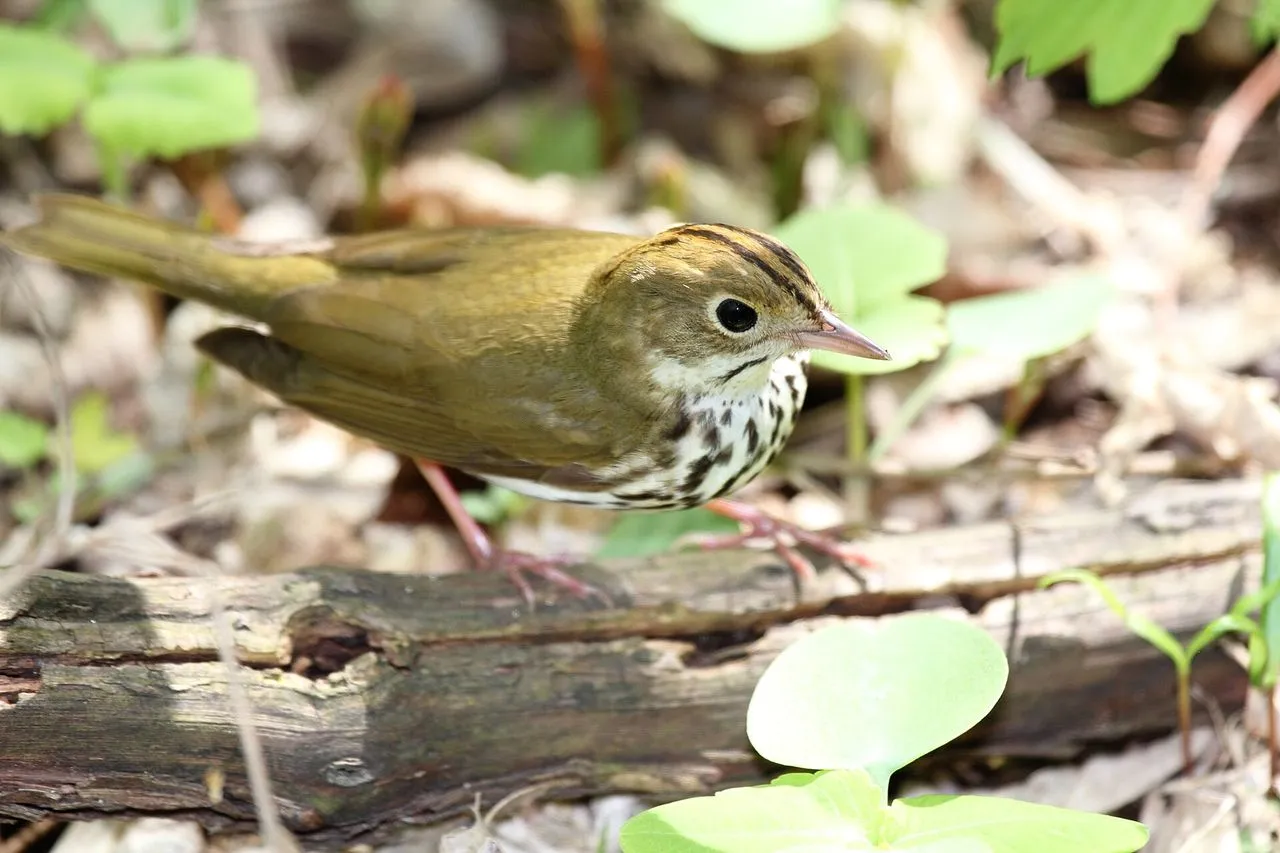
Ovenbird (Seiurus aurocapilla) is a forest-interior warbler (14–16cm, 16–28g) that walks on the forest floor like a sparrow. Has orange-rufous crown stripe bordered by black. Song is loud 'teacher-teacher-teacher'. Named for its domed nest.
Seiurus aurocapilla Linnaeus, 1766, the Ovenbird, is a 14 to 16 cm forest warbler of 16 to 28 g that walks on the leaf litter and sings one of the loudest territorial songs in eastern woodland.
Part of the Complete Warblers Guide.
Identification at a glance
| Feature | Ovenbird (Seiurus aurocapilla) | Key separator |
|---|---|---|
| Crown | Orange central stripe bordered by black | Cleaner crown mark than waterthrushes show |
| Underparts | White with heavy black spotting | Thrush-like pattern on a warbler-sized bird |
| Behaviour | Walks on leaf litter with horizontal posture | Does not wag tail like waterthrushes |
| Size | 14 to 16 cm (5.5 to 6.3 in), 16 to 28 g (0.6 to 1.0 oz) | Larger and heavier than most Setophaga warblers |
| Song | Loud accelerating teacher-teacher-teacher | Carries through mature forest interior |
Identification
Visual
Ovenbirds look more like small thrushes than typical warblers. The upperparts are olive-brown, the underparts white with heavy black streaking, and the head carries an orange crown stripe bordered by black lateral stripes. A complete white eye ring gives a large-eyed expression. The legs are pinkish and relatively strong, matching a terrestrial foraging life.
The bird walks rather than hops, stepping across leaf litter with a horizontal posture and occasionally bobbing the head. In migration it may appear under shrubs in gardens or along woodland paths, where the streaked breast and orange crown identify it if seen well. Northern Waterthrush and Louisiana Waterthrush are longer-tailed, more heavily tied to water, and wag the tail; Ovenbird is drier-forest, shorter-tailed, and crown-striped.
Audio
The song is a loud accelerating series conventionally rendered teacher-teacher-teacher, each phrase stronger than the last. It carries 100 m or more through still May forest and is often heard far more often than the bird is seen. Males sing from low or mid-level perches, not from the ground.
A second song, used in flight display and courtship, is more complex and less familiar, delivered during fluttering aerial displays. Calls include a sharp chip and a high thin flight note during nocturnal migration.
Distribution
Breeds across the eastern and central North American forest zone, from south-eastern Canada and the Great Lakes through New England, the Appalachians, and much of the eastern United States west to the edge of the Great Plains. It also breeds through parts of the Canadian boreal mixedwood where mature deciduous or mixed forest structure is available.
Spring migration reaches the southern United States in April and northern breeding grounds from late April through May. Autumn migration begins in August, peaks in September, and continues into October. Winter range includes Florida, the Caribbean, Mexico, Central America, and northern South America, where birds occupy forest floor territories in humid and semi-humid woodland.
Habitat
Breeding Ovenbirds require closed-canopy forest with a well-developed leaf-litter layer and relatively open ground beneath. Mature deciduous and mixed forests are typical, especially oak, maple, beech, birch, hemlock-hardwood, and aspen stands. They avoid dense low vegetation that obstructs walking and reduce in abundance where deer browsing, invasive shrubs, or heavy fragmentation alter the forest floor.
The species is often described as forest-interior because nest success declines near edges where predators and cowbirds increase. It can occur in smaller woodlots, but high reproductive output is more likely in large continuous forest blocks. On wintering grounds it uses shaded forest, secondary woodland, and coffee plantations with sufficient leaf litter.
Diet and Foraging
Ovenbirds feed on arthropods from the forest floor: ants, beetles, caterpillars, spiders, flies, millipedes, and small snails. They walk slowly, pause, and pick prey from leaves, twigs, and exposed soil. They also flip leaves with the bill, though less vigorously than towhees or thrashers.
Foraging height is usually below 30 cm, which places the species in a different niche from most warblers. During outbreaks of defoliating caterpillars, adults may take prey from low foliage, but the core method remains terrestrial. The bird's brown-olive back and streaked underside make it difficult to see until it moves across a patch of pale leaves or crosses a trail.
Breeding Biology
The common name refers to the domed nest, which resembles a small outdoor oven. The female builds it on the ground, embedding a cup within leaves, grasses, bark strips, and rootlets, then roofing it with a dome and side entrance. Placement is usually among dry leaves at the base of a sapling, fern clump, log, or small rise.
Clutch size is usually 4 or 5 eggs. Incubation lasts about 11 to 14 days and is performed by the female. Both parents feed nestlings, which leave the nest at 7 to 10 days and scatter into cover before flight is fully developed. Ground nests are vulnerable to snakes, chipmunks, squirrels, raccoons, and jays. Brown-headed Cowbird parasitism can be high in fragmented landscapes.
Notes
Ovenbird abundance is a practical indicator of forest-floor integrity. A woodland may have tall trees and still be poor Ovenbird habitat if invasive shrubs fill the understory, deer remove regeneration, or trails and edges fragment the litter layer. The song tells the observer that enough continuous, walkable forest floor remains for a ground-nesting warbler to defend territory.
See Also
- Black-and-white Warbler: the bark-creeping, zebra-striped counterpart to the Ovenbird's ground-walking niche.
- Hooded Warbler: another eastern forest understory specialist whose population health reflects forest structure.
- Wood Thrush: the ground-nesting thrush whose forest-floor habitat overlaps with Ovenbird territory.
- Swainson's Thrush: a forest-floor forager that also uses shaded interior woodland.
- The Complete Warblers Guide: family taxonomy, migration, and identification structure.
Frequently Asked Questions
How do I identify Ovenbird?
Orange-rufous crown stripe with black borders is distinctive. Olive-brown upperparts, white underparts with dark spots. Walks rather than hops, often seen on forest floor. Not warbler-like in movement.
What is the Ovenbird song?
Loud, ringing 'teacher-teacher-teacher', one of the loudest songs in eastern forests. The bird often sings from a low perch but can be heard from deep within forest. Essential sound for eastern woodland birding.
Where does Ovenbird nest?
Dense deciduous or mixed forest interior, requires mature forest with leaf litter for foraging. Builds a domed nest on the ground from leaves, grass, and hair, shaped like an old-fashioned oven.
Does Ovenbird use feeders?
No, they are exclusively forest birds that forage on the ground in leaf litter. Never come to feeders. Best found by learning their distinctive song in mature forest.