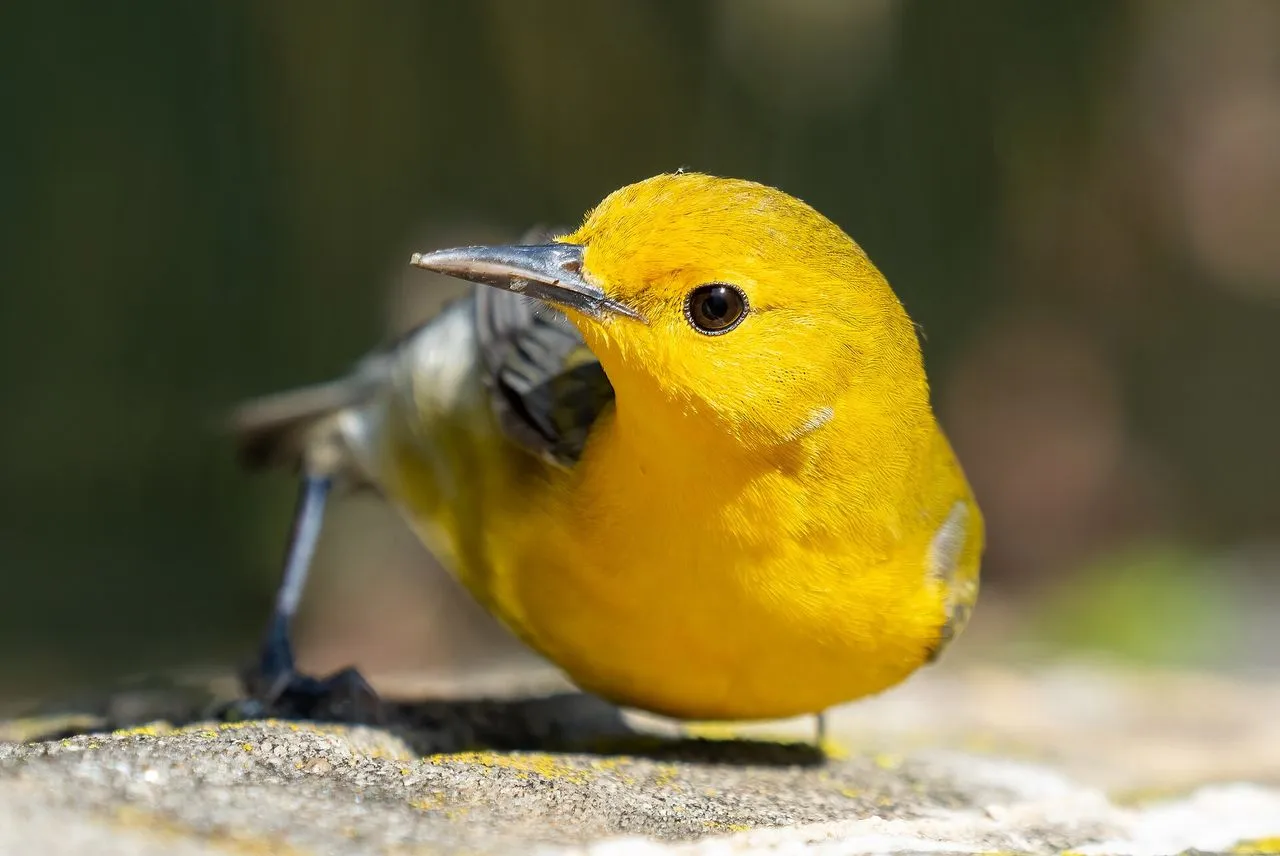
Protonotaria citrea Boddaert, 1783, the Prothonotary Warbler, is a 13 to 14 cm golden-yellow warbler of wooded swamps and one of the few parulids that nests in cavities.
Part of the Complete Warblers Guide.
Identification at a glance
| Feature | Prothonotary Warbler (Protonotaria citrea) | Key separator |
|---|---|---|
| Plumage | Golden-yellow head and underparts, olive back, blue-grey wings | Plain face and white undertail coverts in swamp light |
| Bill | Relatively long and heavy for a warbler | Stronger than Yellow Warbler's fine bill |
| Nesting | Uses cavities in rotten stubs, old holes, or boxes over water | Unusual among warblers, which usually build open cups |
| Size | 13 to 14 cm (5.1 to 5.5 in) | Compact golden swamp warbler |
| Primary habitat | Flooded deciduous forest, cypress-tupelo swamp, bottomland hardwoods | Standing water and cavities are decisive |
Identification
Visual
Adult males show a deep golden-yellow head and underparts, olive back, blue-grey wings, plain face, dark eye, and white undertail coverts. Females are slightly duller, with more olive on the crown and less saturated yellow below. The bill is relatively long and heavy for a warbler. The tail often looks broad and plain from below, without the complex patterning of many Setophaga species.
In good light the bird appears almost lantern-like against shaded swamp forest. No other eastern warbler combines a plain golden head, blue-grey wings, white undertail, and cavity-nesting swamp behaviour. Yellow Warbler is smaller-billed, streaked in males, and associated with shrubs rather than flooded timber. Hooded Warbler has a dark hood or face pattern and works dense understory rather than open water and trunks.
Audio
The song is a loud, ringing series of repeated notes, commonly rendered sweet-sweet-sweet-sweet-sweet, delivered at an even pace from low or mid-level perches over water. It lacks the tumbling acceleration of Yellow Warbler and carries strongly through swamp forest. Males sing persistently in April, May, and June.
The call is a sharp, metallic tsip. In flooded forest the song is the main detection cue; visual searches are often blocked by trunks, buttonbush, and reflected glare from water.
Distribution
Breeding range is centred on the eastern United States, especially the Mississippi Alluvial Valley, Gulf Coastal Plain, Atlantic Coastal Plain, and lower Great Lakes region. It breeds locally north to southern Ontario and the upper Midwest and west to eastern Texas and Oklahoma where suitable wooded wetlands remain.
Spring migrants arrive on the Gulf Coast in March and reach northern breeding areas during April and early May. Autumn migration runs from July through September, with many birds moving earlier than canopy-breeding warblers. Winter range lies mainly in mangroves and coastal wetlands from southern Mexico through Central America to northern Colombia and Venezuela, with important concentrations in Panama and the Caribbean slope.
Habitat
The breeding habitat is flooded deciduous forest: cypress-tupelo swamps, bottomland hardwoods, oxbow margins, wooded sloughs, beaver ponds, and river floodplains with standing dead timber. Water beneath or near the nest site is a strong predictor of occupancy because it reduces access by some mammalian predators.
The species also uses nest boxes placed over water, especially where natural cavities are scarce. Suitable boxes must be low, shaded, and near or above standing water; a box on a dry garden fence is not equivalent habitat. Winter habitat is often mangrove forest, where birds defend linear territories along channels and edges.
Diet and Foraging
Prothonotary Warblers feed on aquatic and semi-aquatic insects, caterpillars, beetles, flies, mayflies, spiders, snails, and occasionally small crustaceans. They glean from trunks, low branches, vines, floating debris, and foliage over water. Short sallies over channels catch emerging insects.
Foraging is usually low, from near water level to about 6 m, though singing males may perch higher. The bird moves deliberately through swamp structure, often crossing open water in short flights between trunks. On wintering grounds it takes insects from mangrove leaves, bark, and pneumatophores, and habitat loss there has direct consequences for breeding populations thousands of kilometres north. Comparable low-foraging swamp warblers include the Hooded Warbler of southeastern understory and the Common Yellowthroat of dense wetland vegetation.
Breeding Biology
Unlike most warblers, Prothonotary Warblers nest in cavities. Natural sites include old Downy Woodpecker holes, chickadee cavities, rotten stubs, and cavities in cypress knees or broken branches, usually 0.5 to 3 m above water. Females add moss, leaves, bark, rootlets, and cypress needles, building a cup within the cavity.
Clutch size is usually 4 to 6 eggs. Incubation lasts about 12 days and is performed by the female. Both adults provision nestlings, which fledge at 10 to 11 days. Two broods may occur in the southern range. House Wrens may destroy eggs in boxes or cavities, and Brown-headed Cowbirds can parasitise accessible nests, though cavity nesting reduces exposure compared with open-cup warblers.
Notes
The species' conservation problem is not a single-site issue. It requires flooded forest with cavities on the breeding grounds, safe stopover habitat during migration, and intact mangroves in winter. Draining bottomland hardwoods or clearing mangroves removes different parts of the same annual cycle. Local nest-box programmes help only where the surrounding wetland still supplies food and water-protected nesting conditions.
See Also
- Hooded Warbler: southeastern understory specialist with overlapping breeding range and similar forest structure needs.
- Wood Duck: the cavity-nesting waterfowl that shares flooded forest habitat and the use of nest boxes over water.
- Yellow Warbler: a brighter shrub-nesting comparison for yellow plumage and low cover.
- Common Yellowthroat: the dense-wetland warbler that also uses rank vegetation near water.
- The Complete Warblers Guide: family taxonomy, migration, and identification structure.
Frequently Asked Questions
How do I identify Prothonotary Warbler?
Unmistakable in good light: deep golden-yellow head and underparts, blue-grey wings, plain face, dark eye, and white undertail coverts. The relatively long, heavy bill distinguishes it from smaller yellow warblers. No other eastern warbler combines plain golden head, blue-grey wings, and swamp-foraging behavior.
Why is Prothonotary Warbler unusual among warblers?
It's one of the few warbler species that nests in cavities, using old woodpecker holes, natural cavities in rotten stubs, or nest boxes over water. Most other warblers build open-cup nests in shrubs or on the ground.
Where does Prothonotary Warbler breed?
Flooded deciduous forest: cypress-tupelo swamps, bottomland hardwoods, oxbow margins, and wooded sloughs across the eastern US, especially the Mississippi Alluvial Valley, Gulf Coastal Plain, and Atlantic Coastal Plain. Requires standing dead timber with cavities near or above water.
What conservation challenges does Prothonotary Warbler face?
Draining bottomland hardwoods removes breeding habitat; clearing mangroves on wintering grounds removes wintering habitat. Both ends of the annual cycle need protection. Local nest-box programmes help only where the surrounding wetland still supplies food and water-protected nesting conditions.
Sources & References
- Ehrlich, P.R., Dobkin, D.S. & Wheye, D. (1988). The Birders Handbook. Simon & Schuster.
- Cornell Lab of Ornithology. (2024). All About Birds: Prothonotary Warbler. birds.cornell.edu
- Sibley, D.A. (2014). The Sibley Guide to Birds (2nd ed.). Knopf.
- Kaufman, K. (1996). Birds of North America. Houghton Mifflin.