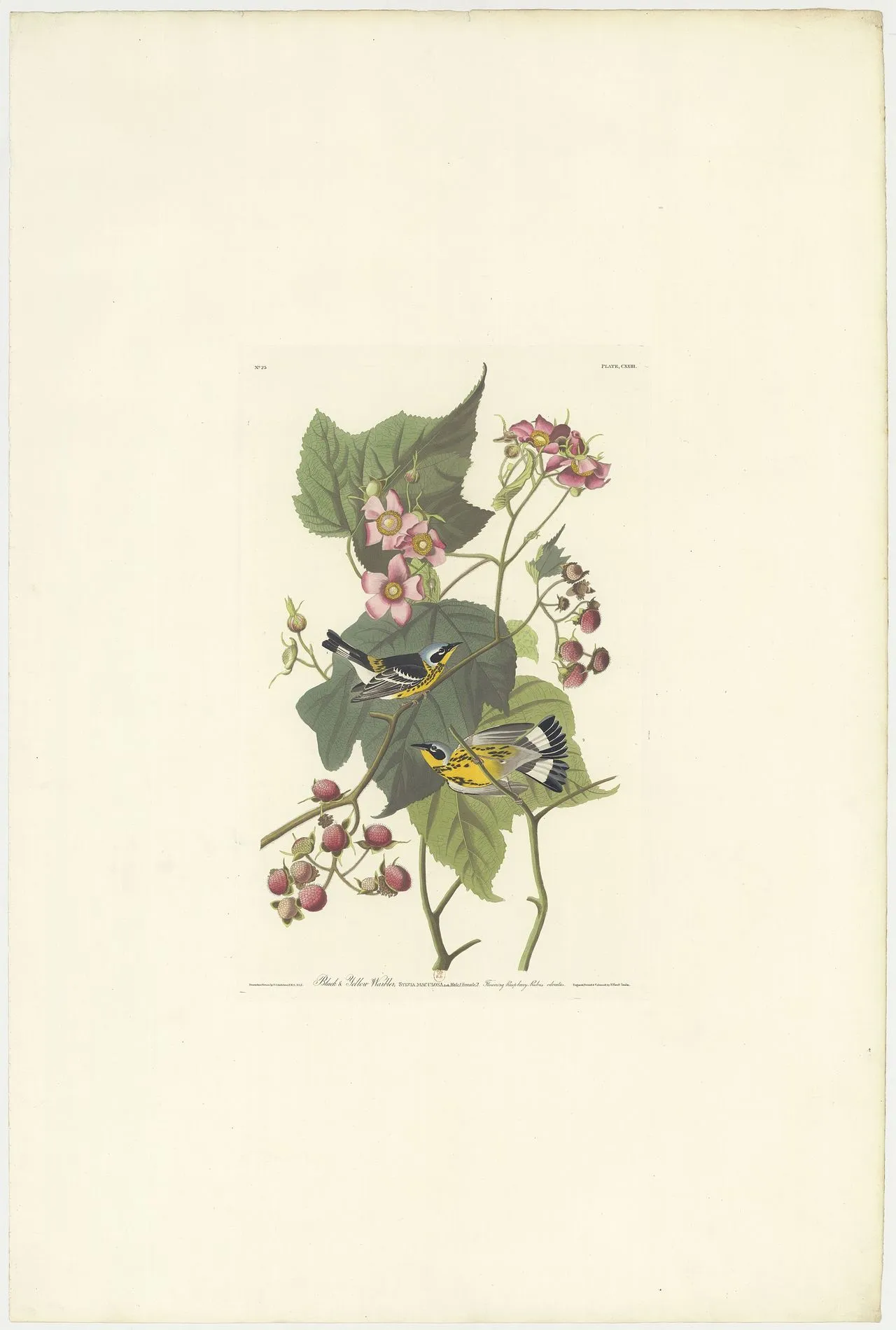
Setophaga magnolia Wilson, 1811, the Magnolia Warbler, is an 11 to 13 cm boreal-breeding warbler of 6 to 12 g whose broad white tail patches identify it in spring and autumn.
Part of the Complete Warblers Guide.
Identification at a glance
| Species | Key separator |
|---|---|
| Magnolia Warbler (Setophaga magnolia) | Broad white tail patches with dark terminal band; yellow underparts in most plumages |
| American Redstart (Setophaga ruticilla) | Female and immature birds show yellow wing and tail patches plus repeated tail-fanning |
| Canada Warbler (Cardellina canadensis) | Grey hood and necklace; lacks Magnolia's broad white tail patch |
| Blackburnian Warbler (Setophaga fusca) | Orange or yellow-orange throat; usually higher in conifer canopy |
| Size context | Magnolia is 11 to 13 cm (4.3 to 5.1 in), 6 to 12 g (0.2 to 0.4 oz) |
Identification
Visual
Breeding males have a black mask, white eyebrow, grey crown, black back streaking, white wing patch, yellow throat and underparts, and bold black streaks forming a necklace across the breast and flanks. The rump is yellow-green. The tail pattern is crucial: white patches occupy the middle of the tail, with a dark terminal band, producing a broad white flash when the tail opens from below.
Females and autumn birds are duller, with reduced black on the face and breast, but the yellow underparts, greyish head, wing bars or wing patch, and tail pattern remain. Immature birds can look deceptively plain in September. Watching the underside of the tail as the bird flicks or changes perch is often more reliable than judging breast streaks through foliage. Canada Warbler has a necklace too, but lacks the Magnolia's white tail pattern and has a stronger eye ring.
Audio
The song is a short, rising phrase often rendered weeta-weeta-WEET, with the final note accented. It is less buzzy than many Setophaga songs and usually delivered from low to mid-level conifers or saplings. Males may sing persistently in June on boreal territories but are less conspicuous vocally during migration.
The call is a sharp chip, broadly similar to other wood-warblers. In autumn, visual identification is usually more dependable than call identification unless the observer has extensive experience with migrant chip notes.
Distribution
Breeding range lies mainly in the boreal forest, from eastern British Columbia and Alberta across Canada to Newfoundland and south into the northern Great Lakes, New England, Adirondacks, and Appalachian highlands. The species favours cool, moist coniferous and mixed forests rather than southern lowland deciduous woods.
Spring migration is concentrated in May across the eastern United States, with Gulf Coast arrivals in April and northern territories occupied from late May into June. Autumn migration begins in August and peaks through September. Winter range extends from southern Mexico through Central America to Panama, with many birds in mid-elevation forest, shade coffee, and second growth.
Habitat
Breeding habitat includes young spruce, fir, hemlock, and mixed conifer-hardwood stands with dense low growth. Magnolia Warblers often occupy regenerating conifer patches, forest edges within boreal landscapes, and openings with saplings rather than the highest closed canopy. In the Appalachians they breed in cool spruce-fir and hemlock-rhododendron zones.
During migration they are less tied to conifers and use deciduous woodland, parks, hedgerows, and garden trees. The species frequently feeds at eye level or below during migration, making it one of the more regularly observed warblers in May and September.
Diet and Foraging
Diet consists mainly of caterpillars, beetles, flies, moths, leafhoppers, aphids, and spiders. On breeding territories birds glean from needles, leaf undersides, and small branches, often in dense young growth. They also hover briefly to take prey from foliage tips.
During migration Magnolia Warblers forage actively from shrubs to mid-canopy, making short hops and tail flicks. They inspect leaf clusters thoroughly rather than sallying repeatedly like American Redstarts. Small berries may be eaten in late summer or on wintering grounds, but arthropods dominate the annual diet.
Breeding Biology
The nest is usually placed low in a conifer, often 0.5 to 2 m above ground in dense spruce or fir. This low nest placement contrasts with canopy species such as Blackburnian Warbler. The female builds a cup of grass, weed stems, bark strips, and rootlets, lined with hair and fine fibres.
Clutch size is typically 3 to 5 eggs. Incubation lasts about 11 to 13 days, mostly by the female. Both parents feed nestlings, which fledge at around 8 to 10 days. One brood is normal in northern breeding areas. Nest success depends strongly on concealment within dense young conifers, where visual predators have difficulty locating the cup.
Notes
The name "Magnolia" is historically misleading. Wilson collected an early specimen in a magnolia tree during migration in Mississippi, but the species is not a magnolia specialist and does not breed in southern magnolia woodland. Its true ecological centre is boreal and montane conifer growth. The field observer should treat the tail pattern, not the name, as the stable clue.
See Also
- Blackburnian Warbler: the boreal canopy specialist with overlapping breeding range in spruce-fir zone.
- Palm Warbler: the boreal ground-forager that shares breeding habitat in open muskeg and bog edges.
- Yellow-rumped Warbler: the boreal parulid that also uses spruce and fir forest and survives on berries through winter.
- American Redstart: the active forager with bold tail display that shares migration timing and low-level feeding behaviour.
- The Complete Warblers Guide: full family reference: taxonomy, migration, and identification structure.
- Northern Parula: another small canopy warbler with distinctive song; both species share boreal mixed-forest breeding habitat.
Frequently Asked Questions
How do I identify Magnolia Warbler?
Breeding males show yellow underparts, grey crown, black mask, streaked back, and a broad white band across the middle of the tail (visible from below). Females are duller but show yellow below, greyish head, and the same tail pattern. The white tail flash is the most reliable field mark in any season.
What is the Magnolia Warbler's tail pattern?
White patches occupy the middle of the tail with a dark terminal band, producing a broad white flash when the tail opens from below. This pattern is visible in all plumages and is often the first clue in the field, especially in migration when the bird may be otherwise dull.
Where does Magnolia Warbler breed?
Boreal forest from eastern British Columbia and Alberta across Canada to Newfoundland, south into the northern Great Lakes, New England, Adirondacks, and Appalachian highlands. Favors young spruce, fir, hemlock, and mixed conifer-hardwood stands with dense low growth, often regenerating conifer patches rather than highest closed canopy.
How does Magnolia Warbler differ from Canada Warbler?
Both have necklaces, but Magnolia Warbler shows a distinctive white tail pattern that Canada Warbler lacks. Magnolia has a white eyebrow, while Canada Warbler shows a grey hood with no eye ring. The tail pattern is the clearest separator.
Sources & References
- Ehrlich, P.R., Dobkin, D.S. & Wheye, D. (1988). The Birders Handbook. Simon & Schuster.
- Cornell Lab of Ornithology. (2024). All About Birds: Magnolia Warbler. birds.cornell.edu
- Sibley, D.A. (2014). The Sibley Guide to Birds (2nd ed.). Knopf.
- Elphick, J. (2015). The Birds of Canada. Princeton University Press.